
One day, my young nephew asked me, "Uncle, why are there so many stars in the sky?" I told him that besides the stars, eight planets are also orbiting right above our heads. Surprised, he asked, "Wait—what is a planet?" Answering his question made me realize just how fun the story of our solar system is when told in simple words.
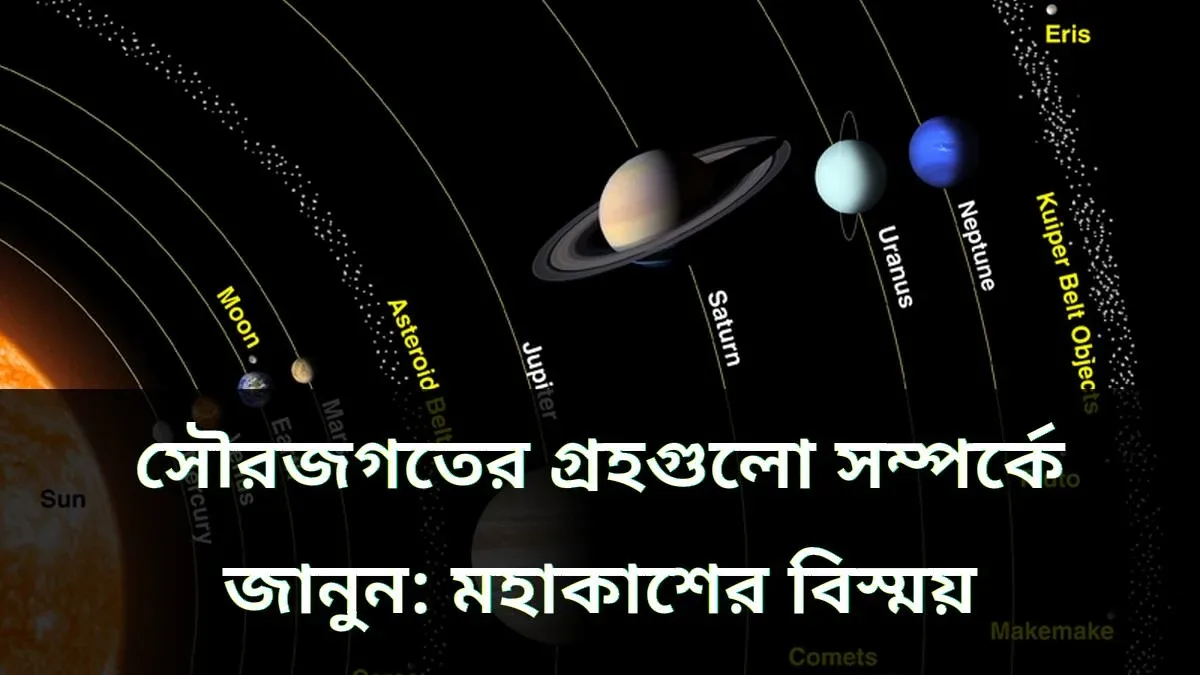
When we look up at the night sky, we see the Moon and the stars. Yet far more is moving silently above us. Eight planets orbit around the Sun. Together, these eight planets, their moons, comets, and asteroids form our solar system. Every planet has its own personality: some are scorching hot like a furnace, while others are freezing cold like ice. On one planet, a day lasts barely ten hours; on another, a single year equals more than a century on Earth.
Introducing Our Solar System
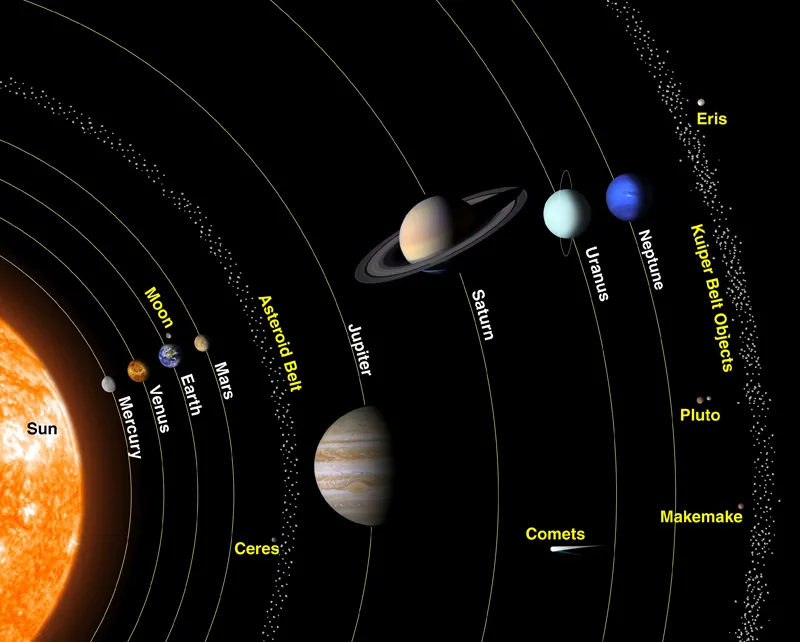
At the center of our solar system sits the Sun. The Sun is a star, and eight planets travel around it. In order of distance from the Sun, they are Mercury, Venus, Earth, Mars, Jupiter, Saturn, Uranus, and Neptune. Earth is roughly 150 million kilometers away from the Sun, and sunlight takes about eight minutes to reach us.
Our solar system is about 4.5 billion years old. Scientists believe the Sun and the planets formed from a massive cloud of dust and gas. The planets move around the Sun along elliptical paths called orbits. Each planet also spins on its own axis at a different speed, which is why days are short on some worlds and remarkably long on others.

Mercury and Venus: The Two Worlds Closest to the Sun
Mercury is the closest planet to the Sun and the smallest planet in our solar system. Daytime temperatures on Mercury soar past 400°C, while nights plunge to minus 180°C. Why such an extreme swing? Because Mercury has no real atmosphere to trap heat. One year on Mercury lasts just 88 Earth days—less than three months.
Venus is Earth's closest planetary neighbor and is nearly the same size as Earth, earning it the nickname Earth's twin. Yet its environment is brutal. Wrapped in a thick blanket of carbon dioxide, Venus has surface temperatures around 460°C, making it the hottest planet in the solar system. Because it shines brightly in the morning and evening sky, people often call it the Morning Star or Evening Star—that bright "star" you spot first at dusk is actually Venus.
Earth and Mars: The Search for Life
Earth is our home. As the third planet from the Sun, it is the only known world where life exists. Roughly three-quarters of Earth's surface is covered in water, and one-quarter is land. Its atmosphere holds oxygen, and its temperatures are just right to sustain life. Earth takes 365 days to complete one orbit around the Sun.
Mars is known as the Red Planet because iron oxide—essentially rust—gives its soil a reddish tint. Scientists believe liquid water once flowed on Mars, and ice still exists at its poles today. Researchers are actively searching for signs of past or present life there, with NASA rovers studying Martian rocks and soil. Mars has two small moons, Phobos and Deimos. Many hope humans will walk on Mars one day—perhaps my nephew's generation will be the one to see it.
Jupiter and Saturn: The Two Gas Giants
Jupiter is the largest planet in the solar system—so massive that roughly 1,300 Earths could fit inside it. Made mostly of hydrogen and helium gas, Jupiter is famous for its Great Red Spot, a colossal storm that has been raging for more than 300 years. Imagine a single storm lasting three centuries!
Jupiter also boasts the most moons, around 95. Saturn, meanwhile, is famous for its dazzling rings made of ice and rock. Seen through a telescope, Saturn looks breathtaking. Like Jupiter, Saturn is a gas giant—and its density is so low that if you could place it in a giant ocean of water, it would actually float. Saturn's largest moon, Titan, even has a thick atmosphere of its own.
Uranus and Neptune: The Distant Ice Giants
Uranus is the seventh planet from the Sun and spins tilted sharply on its side. Scientists suspect a massive collision knocked it over long ago. Methane gas in its atmosphere gives Uranus its pale blue-green color, and it is bitterly cold, with temperatures near minus 200°C.
Neptune is the farthest major planet from the Sun and glows a deep blue. It has the fastest winds in the solar system, whipping past 2,000 kilometers per hour. One year on Neptune equals 165 Earth years. Remarkably, Neptune was first discovered through mathematical calculations before anyone spotted it through a telescope.
Pluto and the Dwarf Planets
Pluto used to be counted as the ninth planet, but in 2006 astronomers reclassified it as a dwarf planet because of its small size and because it has not cleared other objects from its orbital path. Alongside Pluto, there are four other recognized dwarf planets: Ceres, Eris, Haumea, and Makemake.
Beyond the planets, the solar system holds plenty more wonders. Between Mars and Jupiter lies the asteroid belt, where millions of rocky fragments orbit the Sun. Comets occasionally swing close to the Sun, glowing with long tails, while meteors burn up as they enter Earth's atmosphere—what we fondly call shooting stars.
FAQ
How many planets are in the solar system?
There are eight planets in our solar system: Mercury, Venus, Earth, Mars, Jupiter, Saturn, Uranus, and Neptune. Pluto is now classified as a dwarf planet.
Which is the largest planet?
Jupiter is the largest planet in the solar system—about 1,300 Earths could fit inside it. It also has the highest number of moons.
Is there life on any planet other than Earth?
So far, no evidence of life has been found outside Earth. However, scientists are actively searching for signs of life on Mars by studying its soil and polar ice.

Discussion & Comments (0)
No comments on this post yet. Be the first to comment!