

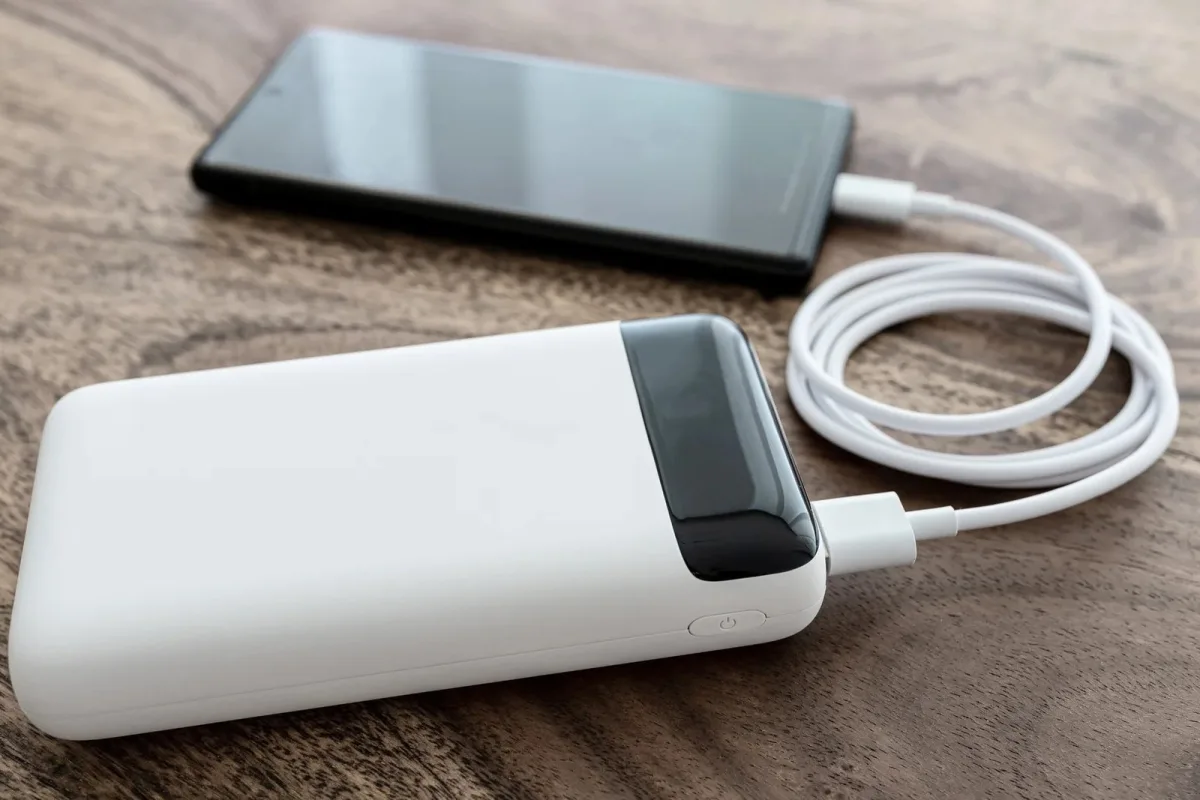
Almost everyone has the same experience when buying a power bank—the box boldly says 10,000mAh, yet when you get home, it barely charges your phone a little over once, let alone twice. Naturally, it feels like the seller cheated you or sold a counterfeit product. In most cases, however, there is a simple scientific calculation behind it, and not knowing it creates a big gap between expectations and reality. In this guide, we explain that math in plain language so that before your next purchase, you can calculate for yourself how many times a power bank will actually charge your phone.
The Real Math: It Comes Down to Voltage
The capacity printed on a power bank is measured at the voltage of its internal battery cells, which is typically 3.7 volts. Your phone, however, charges at 5 volts. When stepping up that internal power to 5 volts, the milliamp-hour figure drops proportionally. The simple formula is: rated capacity multiplied by 3.7, divided by 5. For a 10,000mAh unit, that comes out to 10,000 × 3.7 ÷ 5, or roughly 7,400mAh. In other words, about 26 percent disappears during voltage conversion alone—even without any defect. The same rule applies to any size: a 20,000mAh power bank starts at roughly 14,800mAh.
- Rated capacity is calculated at 3.7 volts.
- Phones charge at 5 volts, which lowers the usable mAh figure.
- Formula: rated capacity × 3.7 ÷ 5.
- A 10,000mAh rating translates to about 7,400mAh before losses.
- This reduction is not a scam—it is basic physics.
There is one more step after that. During voltage conversion, some energy is lost as heat, known as conversion loss. Even in a good-quality power bank, this loss is typically 10 to 15 percent.
How Much Charge Actually Reaches Your Phone
Now let's put the full calculation together. Subtracting another 10 to 15 percent from 7,400mAh leaves roughly 6,200 to 6,700mAh—that is the actual charge delivered to your phone. If your phone has a 5,000mAh battery, this power bank will give you about 1.2 to 1.3 full charges. Expecting two full charges was unrealistic from the start. With a smaller phone battery, such as 4,000mAh, you can get closer to one and a half charges. Checking your phone's battery size and running this quick math beforehand keeps your expectations realistic and prevents disappointment.
- Conversion loss uses up another 10 to 15 percent of energy.
- A 10,000mAh unit delivers roughly 6,500mAh in practice.
- A 5,000mAh phone gets about 1.25 full charges.
- Phones with smaller batteries get more charges.
- Use the exact same ratio when estimating a 20,000mAh unit.
Keep one more thing in mind: if your phone is powered on and running mobile data or games while charging, part of that energy is consumed immediately. As a result, real-world charging can feel slightly lower than the math suggests, which is completely normal.
What Else to Check Before Buying
Buying a power bank based solely on its capacity number is not wise. If your phone supports fast charging, check whether the power bank supports the same protocol; otherwise, charging will be painfully slow. Port types and count matter too—make sure they match your cable and check whether you can charge two devices at once. Weight is another practical factor: high-capacity power banks are heavy and can be a burden to carry daily. Most importantly, look for a trusted brand with a warranty. Reputable brands include safety circuits that reduce the risk of overheating or short circuits. Paying a little more for safety is well worth it.
- Match the power bank's fast-charging support to your phone.
- Check port types, port count, and whether a cable is included.
- Consider weight if you plan to carry it every day.
- Choose a brand that offers a warranty and after-sales support.
- Avoid suspiciously cheap, unbranded power banks.
⚠ Warning: The market is full of ultra-cheap, oversized fake power banks labeled 50,000mAh that contain tiny, low-grade cells inside. Not only do they deliver very little charge, they can also overheat, swell, or even explode. Whenever you see an unbelievable price paired with an unbelievable capacity claim, stay alert—never compromise on safety.
Final Thoughts
The number printed on a power bank is not a lie; it is simply measured on a different basis. Once you understand voltage conversion and normal energy loss, you can accurately estimate the real output of any power bank. Getting just over one full charge for a 5,000mAh phone from a 10,000mAh unit is completely normal and expected. Shopping with this knowledge helps you avoid getting misled and ensures you get fair value for your money.
Think about your own routine before buying. If you spend long hours outside every day, a larger capacity makes sense; for occasional emergencies, a compact, lightweight unit is plenty. There is no point carrying extra weight by buying the biggest model you don't need.
Ultimately, a good power bank is a long-term companion. If you do a little checking, understand the math, and buy from a reliable seller, it will keep your phone running safely for years—right when you need it most.
📱 Join my Telegram channel for more daily tips like this: https://t.me/earnhelosp




Discussion & Comments (0)
No comments on this post yet. Be the first to comment!