
Even after working hard to write a great article, bloggers often feel frustrated when it does not appear on Google Search or stays stuck in the 'Discovered - currently not indexed' state. One of the main reasons for this is a lack of On-Page SEO (Search Engine Optimization) and thin content with too few words. Google's algorithm is now much more advanced; it does not just look for keywords, but evaluates how well-structured, detailed, and technically accurate the writing is for readers. Following a clear On-Page SEO checklist before publishing every post greatly increases your chances of getting organic visitors.
6 Essential SEO Checklists Before Publishing an Article
Be sure to check the following 6 items every time you write a new post:
- Compelling Title (50–60 characters): Place the primary keyword near the beginning of the title and write it in a way that makes readers eager to click when they see it in search results.
- Clean and Short URL Slug: Instead of long numbers, use a clean hyphenated slug in English or Banglish words (such as on-page-seo-checklist); this helps both Google and readers easily understand the topic of the link.
- Meta Description (140–155 characters): Write the core summary of the post so that it includes the main keyword and gives readers a clear reason to read the full post.
- Proper Heading Structure (H1, H2, H3): Keep only one H1 tag for the title on a page and organize the main content neatly using H2 and H3 subheadings.
- Internal and External Linking: Add links to related older posts or free tools on your site inside the new post; this keeps visitors on your site longer and helps crawlers discover all pages easily.
- Image Optimization and Alt Text: Compress every image in WebP format (under 100–200 KB) before uploading and add a descriptive alt attribute to every
tag.
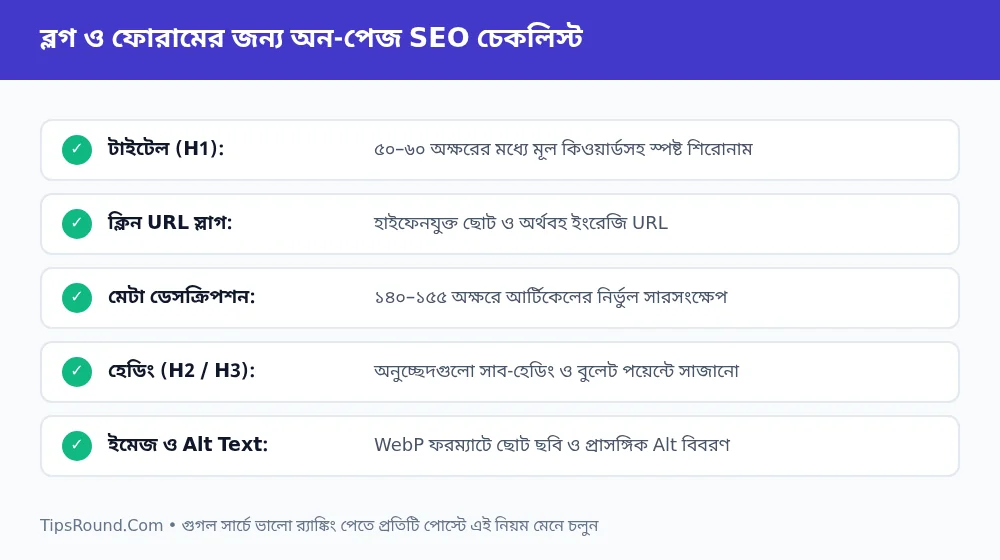 Title, slug, meta, and image SEO checklist before publishing an article
Word Count, Depth, and Avoiding Thin Content
Many people publish short 150–200 word posts, which are nearly impossible to rank on Google. Every tutorial or guide should have at least 500 to 800+ words with detailed steps, warnings, and an FAQ (Frequently Asked Questions) section at the end. This makes the article complete and creates an opportunity to appear in Google's Featured Snippet.
Technical SEO and Search Console Monitoring
After publishing a post, check whether your sitemap.xml is updating automatically and whether the canonical URL () is set properly. If you change any old link, always use a 301 Redirect so that 404 or Redirect Errors do not occur.
Off-Page and Community Signals for a New Site
Along with perfecting On-Page SEO, the following steps help your articles get noticed faster:
- Consistent Publishing Schedule: Instead of publishing 10 posts in a single day, publishing 3–4 quality posts on specific days each week encourages Google crawlers to visit your site regularly.
- Category and Tag Balance: Having sufficient content in every category increases your site's Topical Authority, which plays a major role in rankings.
- Social Sharing Cards: When Open Graph (og:title, og:image) tags are configured properly, sharing a link on Facebook or WhatsApp displays an attractive thumbnail preview.
Frequently Asked Questions (FAQ)
Is an English URL slug better for Bengali keywords?
Yes, when Bengali Unicode URLs are shared, they often turn into long encoded strings (%E0%A6...); therefore, a short and clear English hyphenated slug is best.
How many times should the same keyword be used in a post?
Without unnecessary keyword stuffing, using it naturally in the title, first paragraph, one subheading, and the meta description is enough.
How many days does it usually take for a new post to get indexed?
If the site's sitemap is properly configured and the content is original and detailed, Google usually indexes it within 2 to 7 days.
Conclusion: With regular quality writing and by following this On-Page SEO checklist, bringing steady organic traffic to your site is only a matter of time.

Discussion & Comments (0)
No comments on this post yet. Be the first to comment!